Project 25.3
- PhD student: Lukas Franke
- Supervisor: Luisa María Jaimes Niño
- Co-Supervisors: Shuqing Xu, Susanne Foitzik
- Further TAC-members: Jan Padeken
- Research Group
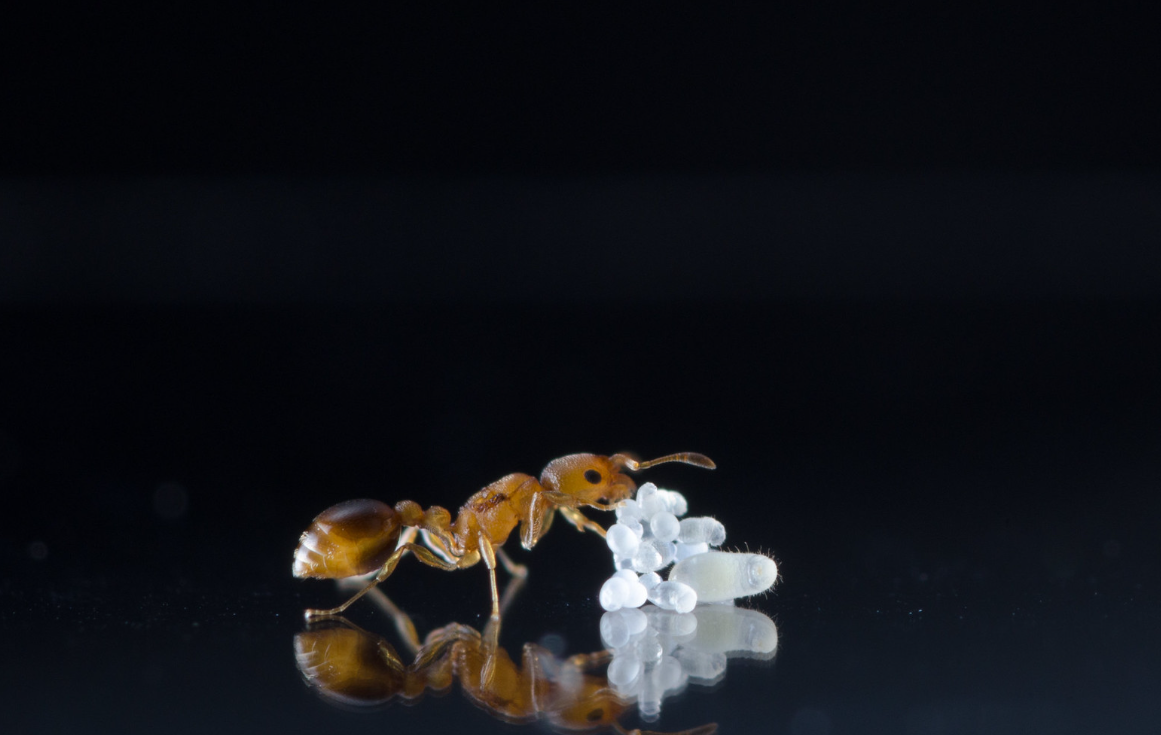
As organisms age, natural selection weakens, creating a “selection shadow” where genes expressed late in life are usually under weaker purifying selection. Contrary to this, purifying selection increases for old-biased genes in queens of the ant Cardiocondyla obscurior. In my PhD, I will investigate how sociality reshapes the selection shadow across tissues and cell types in queens, thereby revealing how reproductive specialization in superorganisms feeds back on the evolution of ageing.
As organisms age, the strength of purifying selection weakens, creating what is known as a “selection shadow”. In solitary insect species, genes that are predominantly active later in life typically show lower sequence conservation than genes expressed at earlier in life. Surprisingly, research on the ant Cardiocondyla obscurior has revealed an opposite trend: In queens, genes with late-life expression can experience stronger purifying selection than those biased toward early life. This pattern suggests a postponed selection shadow and an extended period of sustained health in social insect reproductives.
In this project, we aim to examine how sociality influences the selection shadow across tissues within superorganisms. Our key questions are: Do social insect queens retain purifying selection on late-expressed genes for longer than solitary insects do? How does the intensity of selection differ among cell types? And which tissues display signs of transcriptomic aging toward the end of life?
To explore these questions, we will create a single-cell RNA sequencing atlas of C. obscurior queens, sampling individuals of various ages and from multiple tissues. From this dataset, we will construct a cell-type-specific selection index that links gene expression patterns with evolutionary rates and sequence conservation in age-biased genes. Comparative analyses with Drosophila melanogaster and Caenorhabditis elegans will allow us to place queen aging trajectories in the broader context of solitary model species.
This approach will help pinpoint tissues and cell types that maintain highly conserved gene expression profiles into old age, reflecting continued purifying selection. We predict that reproductive tissues, given their central role in colony fitness, will display particularly strong conservation.
By integrating cellular aging, gene expression dynamics, and molecular evolution in social insects, this project will evaluate how sociality reshapes the selection shadow at the tissue level. The resulting aging atlas and cell-type selection index will provide a comparative foundation for understanding how division of labour and reproductive specialization feed back into the evolution of senescence in superorganisms.